August 29, 2026
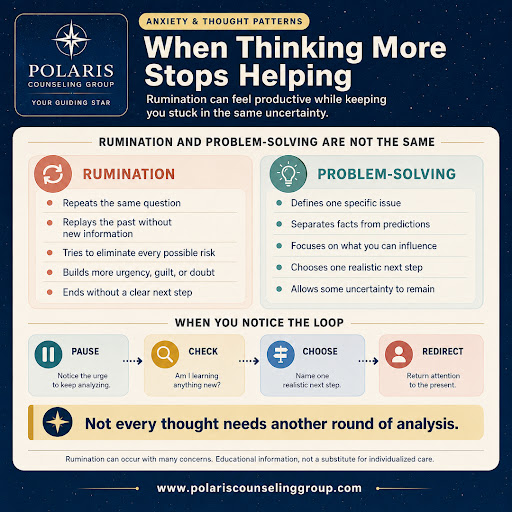
Thinking something through can be helpful. Rumination is different.
Rumination often feels productive because your mind is working hard, but it keeps returning to the same questions without producing new information, a decision, or a workable next step.
It may sound like:
* Why did I say that?
* What if I missed something?
* How can I be completely certain?
* Maybe one more round of analysis will finally make me feel settled.
Problem-solving moves toward a decision or action. Rumination usually moves toward certainty, and complete certainty may never arrive.
When you notice the loop, try asking:
* Am I learning anything new?
* What part of this can I actually influence?
* Is there one reasonable next step I can take?
* Would redirecting my attention be more helpful than analyzing it again?
The goal is not to stop thinking. It is to recognize when thinking has stopped helping.
Therapy can help you understand repetitive thought patterns, respond differently to uncertainty, and build tools for moving forward.
In-person counseling in the Dayton and Cincinnati areas, with online therapy available across Ohio.
https://www.polariscounselinggroup.com
https://www.therapyportal.com/p/polaris45068/appointments/availability/
View Post
August 26, 2026
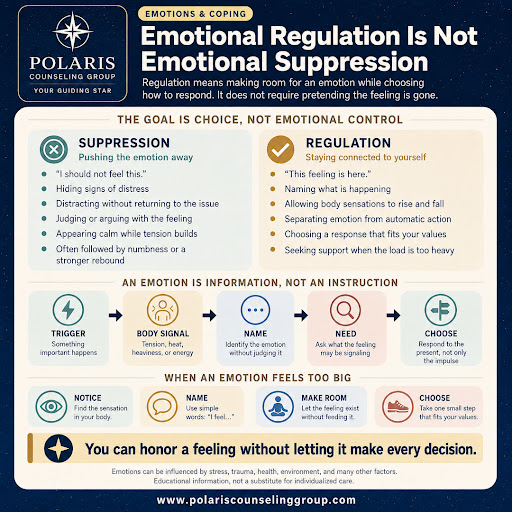
Emotional regulation is sometimes mistaken for staying calm, thinking positively, or making an uncomfortable feeling disappear.
In reality, regulation means recognizing an emotion, allowing it to exist, and creating enough space to choose what happens next. Suppression tries to push the feeling away, hide it, or judge it. That may create temporary control, but tension can continue building underneath or return later as numbness, irritability, exhaustion, or a stronger emotional reaction.
Emotions provide information. Anxiety may signal uncertainty or perceived danger. Anger may point toward hurt, unfairness, or a crossed boundary. Sadness may reflect loss or disconnection. The feeling matters, but it does not have to dictate every decision.
A helpful sequence is to notice what is happening in your body, name the emotion without judgment, consider what it may be signaling, and choose one response that fits the present situation and your values.
Regulation is not about becoming emotionless. It is about staying connected to yourself while gaining more choice in how you respond.
Polaris Counseling Group offers in-person counseling throughout the Dayton and Cincinnati areas, with online therapy available across Ohio.
Learn more or schedule an appointment:
https://www.polariscounselinggroup.com
https://www.therapyportal.com/p/polaris45068/appointments/availability/
View Post
August 17, 2026
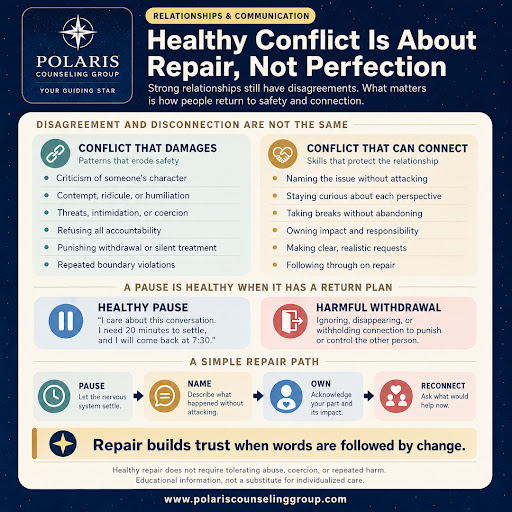
Healthy relationships are not relationships without disagreement. The difference is how conflict is handled and whether both people can eventually return to safety, understanding, and connection.
Conflict becomes damaging when it includes personal attacks, contempt, intimidation, punishment, repeated boundary violations, or a refusal to accept responsibility. Healthier conflict makes room for curiosity, clear requests, accountability, and meaningful repair.
Taking a break can also be healthy when it includes reassurance and a clear plan to return. Disappearing or withholding connection to punish or control someone is different from pausing long enough for the nervous system to settle.
Repair is more than saying the right words. It involves acknowledging impact, accepting responsibility, asking what is needed, and following through with changed behavior.
Healthy repair never requires tolerating abuse, coercion, or repeated harm.
Polaris Counseling Group provides individual and couples counseling in person throughout the Dayton and Cincinnati areas, with online therapy available across Ohio.
www.polariscounselinggroup.com
Learn more or schedule an appointment:
https://www.polariscounselinggroup.com
https://www.therapyportal.com/p/polaris45068/appointments/availability/
View Post